Skip to content
Menu
Vige
Quick foot

Bloggtoons

Cynefin - can Vige make sense in different domain?

Update 2021-11-13

Since I published this illustration more than one year ago I have had the pleasure of creating a new version of the illustration. This new version and the old one is available in high resolution for your use. You can find it in the free material.

Original text

I have been fascinated by the work of Dave Snowden and the Cynefin sense making framework for a long time and a few days ago I got the idea that it would be fun to illustrate the Cynefin framework using the Vige surrounding. In the picture I wanted to capture some of the more important behaviors in each domain and also the fact that the “burden” of structure/constraints that you put on while you move between the different domains increases. I got to work, after some trial and errors I remembered that I had seen a 3D version of Cynefin and with some research I found it. This version was very helpful in succeeding with my goal, as Rob England (the creator of the original 3D version) himself writes.

The vertical axis is “negentropy”: energy, order. It takes energy to make a system chaotic, it settles into complex. Dave Snowden himself made this improvement to the picture. He approved of this 3D view of Cynefin.

So, with the help from my colleagues at Squeed I got this my first version of the picture done. Thanks everyone!

By the way, if you have any suggestions on improving the illustration? Some thoughts that I have myself is to change the cliff to something man made (in this case I guess it is goblin/troll made) to better represent that it is built in some way and can be easily broken if not maintained.

Here you can find the blog post from Dave Snowden when he comments on the original 3D version from Rob England Cognitive Edge
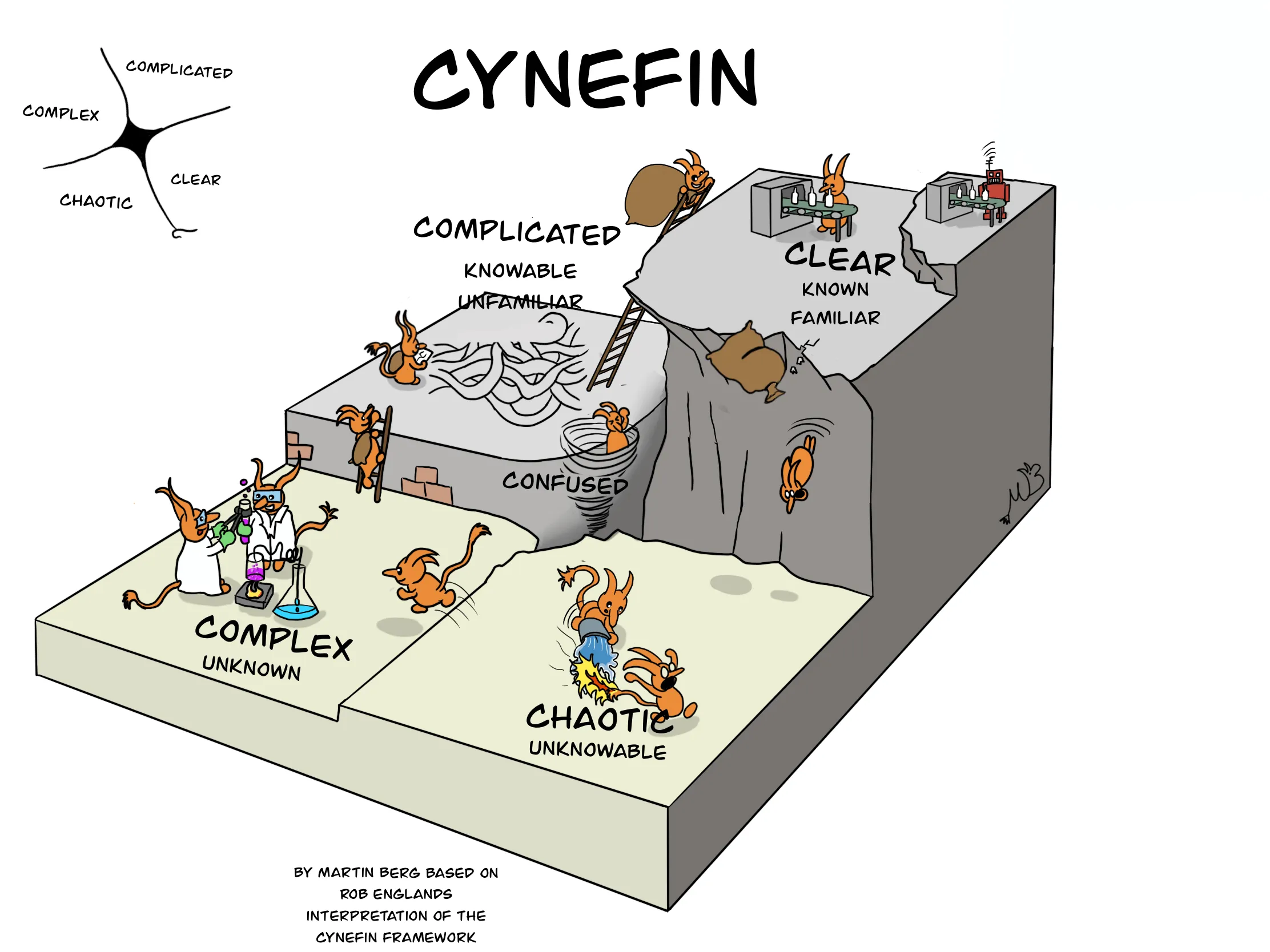
 

The Cynefin framework drawn as a 3D landscape with Vige figures. Clear (known, familiar) is a high plateau with machines and a robot. Complicated (knowable, unfamiliar) is a lower level with a tangle. Complex (unknown) has scientists experimenting, Chaotic (unknowable) has a fire being put out, and a whirlwind marks Confused. A figure falls off the cliff from Clear into Chaotic. By Martin Berg, based on Rob England’s interpretation of the Cynefin framework.

Inspiration to improve

This TED talk was really inspiring (and fun) for me. The fact that a simple picture can give so much extra understanding and meaning is something that I very much can relate to. What I have noticed is that a picture needs some explanation, to help the audience find the path in the picture. It is clearly visible in the performance of Christoph Niemann that it is the combination of the two that really makes the magic. I hope you like the TED talk as much as I did, also below is a small video on how I create Vige.

TED Talk - You are fluent in this language (and don’t even know it)

Prioritization, so much fun

“We really need to do this!” “This is super important!” “Why haven’t this been completed yet?” The life of a team in an organization is not always a walk in the park. In a complex world several things need to be solved at the same time and the value is often not possible to predict beforehand. The person with the immediate need will of course know, but from his/her perspective only and that will not help the team.

So, what to do?

You need intensive communication between team and stakeholders in order to get a shared view, acceptance and understanding on priority.

Easy right?

Well, maybe not so easy. Communication is central in agile but even if you put your full energy into this it will still only work up to a point, sometimes even the best communication turns into a too high cost for the team. If you spend all time discussing prioritization and doing refinement in order to understand the cost of multiple competing needs the team will have too little time to realize the value and then this is waste. At this point the team will probably start to talk about kanban. They feel that everything is in a stand stil and want to get things done, let’s get a flow going. This could be a good enough, you will start to get things flowing through and yes a lot of the things will be the “loudest”-requirements but some of the actual value deliveries will slip through.

But if you really want to fix the problem you must deal with something much harder, dependencies.. If the team is not able to realize value more or less by themselves and instead has high dependencies to other teams, managers or architects, processes you name it you will start to build a prioritization chaos.

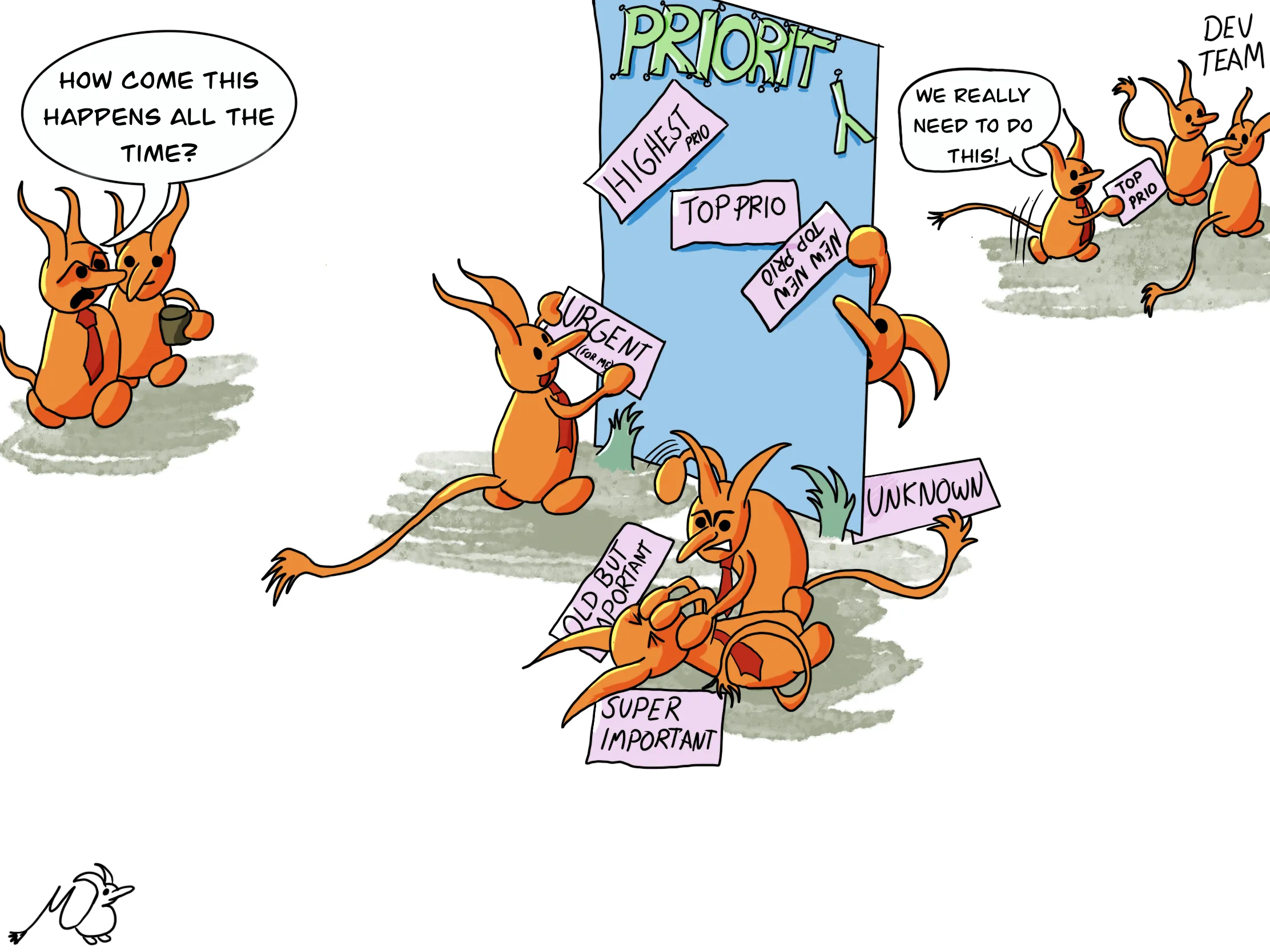
A board titled “Priority” covered with notes: “Highest prio”, “Top prio”, “New new top prio”, “Urgent (for me)”, “Unknown”. Managers in ties fight over the notes on the ground: “Old but important”, “Super important”. A manager runs to the dev team with a “Top prio” note: “We really need to do this!” Two managers with coffee watch: “How come this happens all the time?”

Let's fix that later

It is hard sometimes, hard to resist the urge to postpone finishing or fixing things because other seems more pressing at the time. The decision might seem to be the only thing you could do, but remember that you always impose a risk when doing so. Especially if you leave the issue unattended for a long time, the cost will sneak up upon you.

Picture yourself in your own home.

You are preparing a dinner for you family and friends but you get an important phone call but you are still able to also finish the dinner but now you do not have time to clean up. You spend a great dinner together and everyone is happy. Time to hit the sack, but wait the kitchen is a complete mess, “Nah I’ll do it tomorrow.”

Next morning, good night sleep, time for some nice breakfast, “Maybe I’ll make some scones.” You walk into the kitchen “Yuk what a mess!, I just want some breakfast!”

You decides to make a small breakfast for yourself and the family, you manage to find some clean cutleries and what you need, no problems. But time goes you other important things keeps to get in the way and the kitchen starts to get worse and worse. You notice that you are having difficulties to find the things you need and when you do you need to do minor fixes, such as washing the kitchen knife before you can attend the thing you actually was planning to do. The whole place starts to smell and it is far from inspiring to innovate and create new tasty meals, you take shortcuts.

This is what happens to code if you do not take care of the small things that is needed. The code gets hard to navigate in, it is harder to see what should go where. New ideas gets lost in the murk of bad code. In the State of DevOps report of 2019 they have investigated how technical debt affects productivity and as a consequence software delivery and operational performance and it is visible that technical debt has a significant impact.

So make sure to keep your kitchen clean and well maintained.

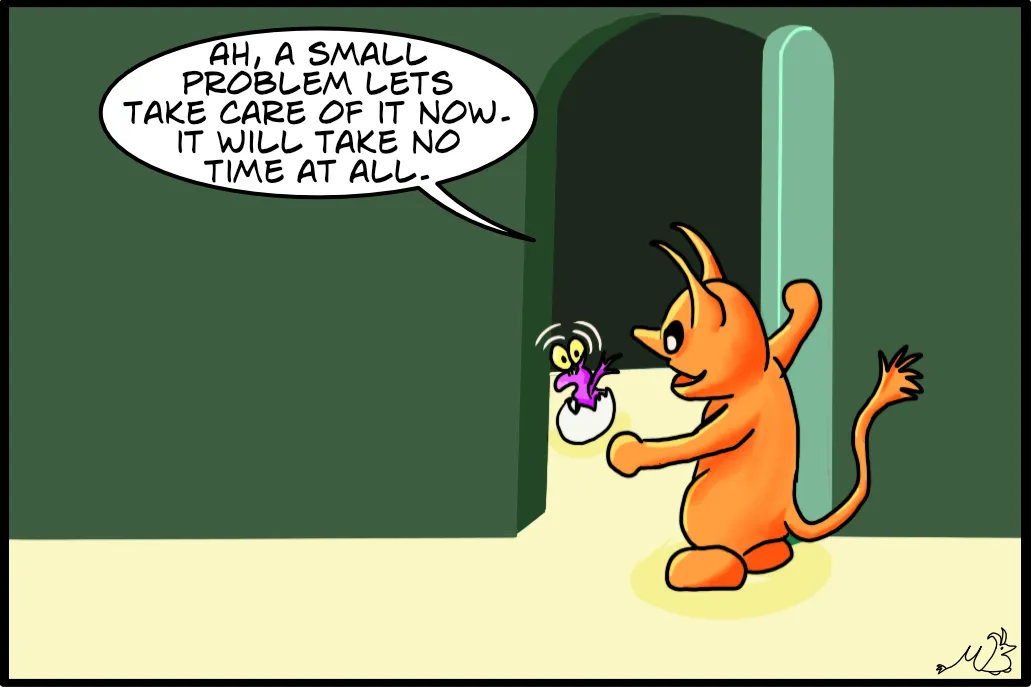
Comic, panel 1. Vige stands in a doorway where a small purple monster is hatching from an egg: “Ah, a small problem lets take care of it now. It will take no time at all.”

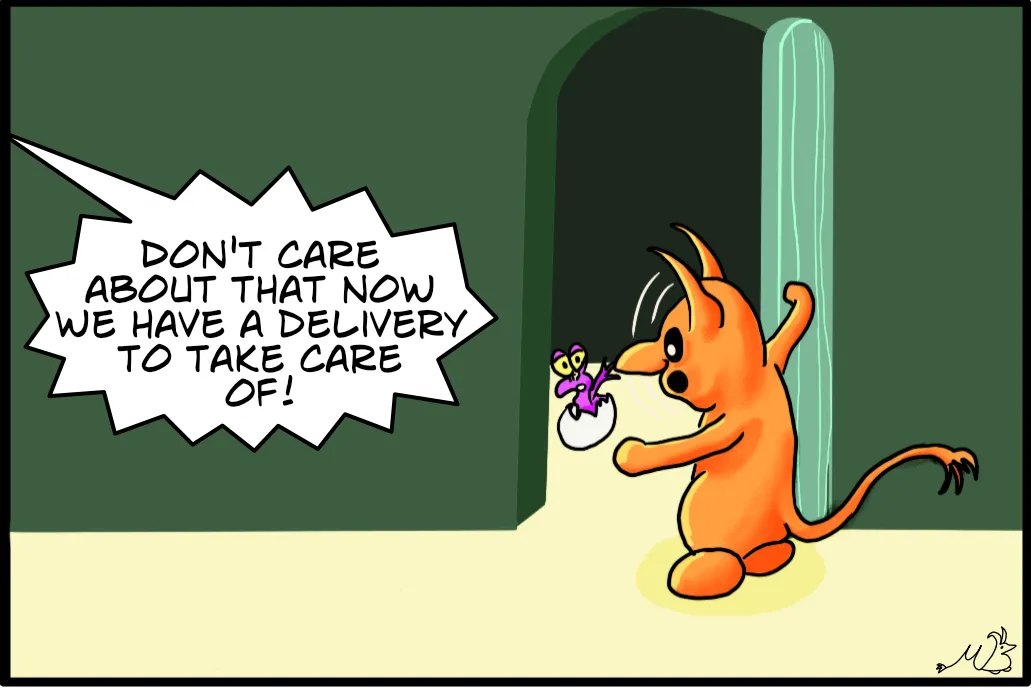
Panel 2. A voice from outside the panel shouts: “Don’t care about that now we have a delivery to take care of!” Vige turns around.

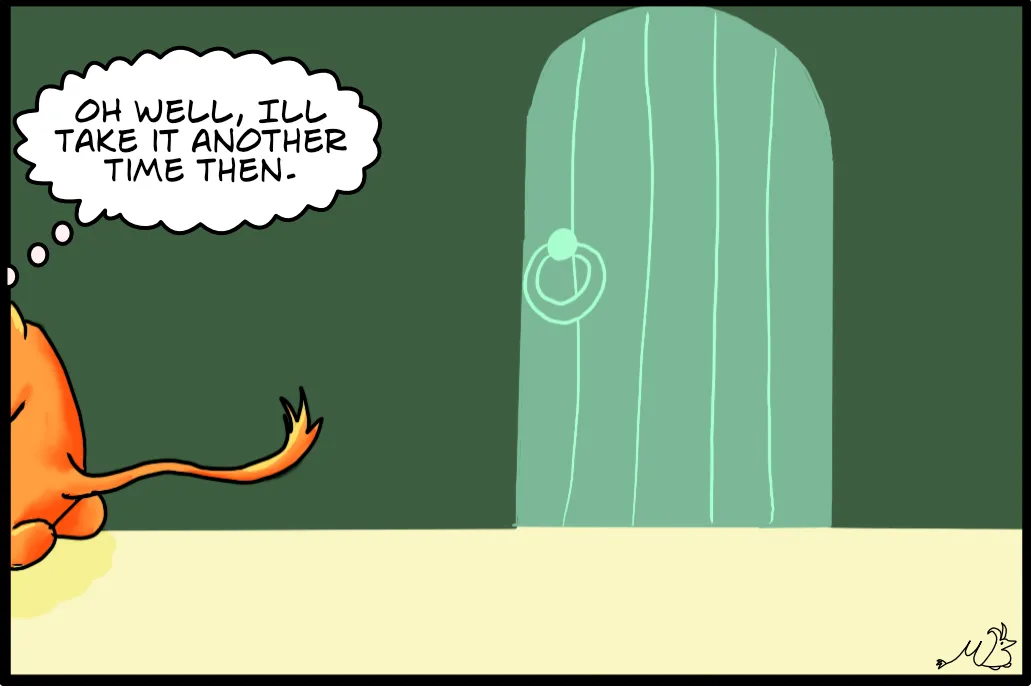
Panel 3. Vige walks away, thinking: “Oh well, Ill take it another time then.” The door is closed.

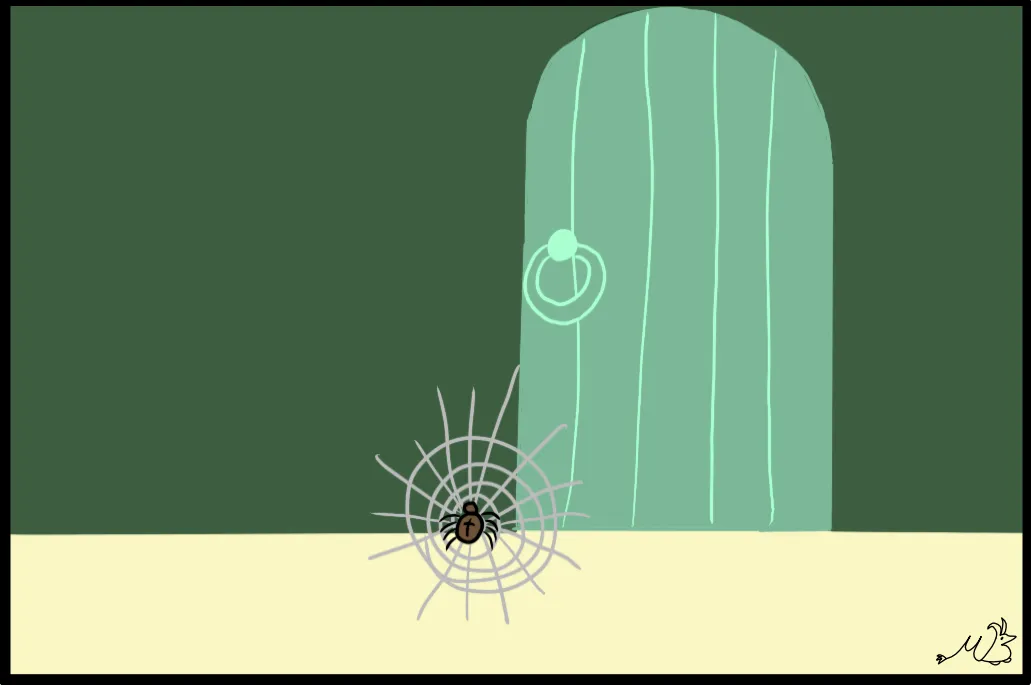
Panel 4. The closed door. A spider has spun a web in front of it.

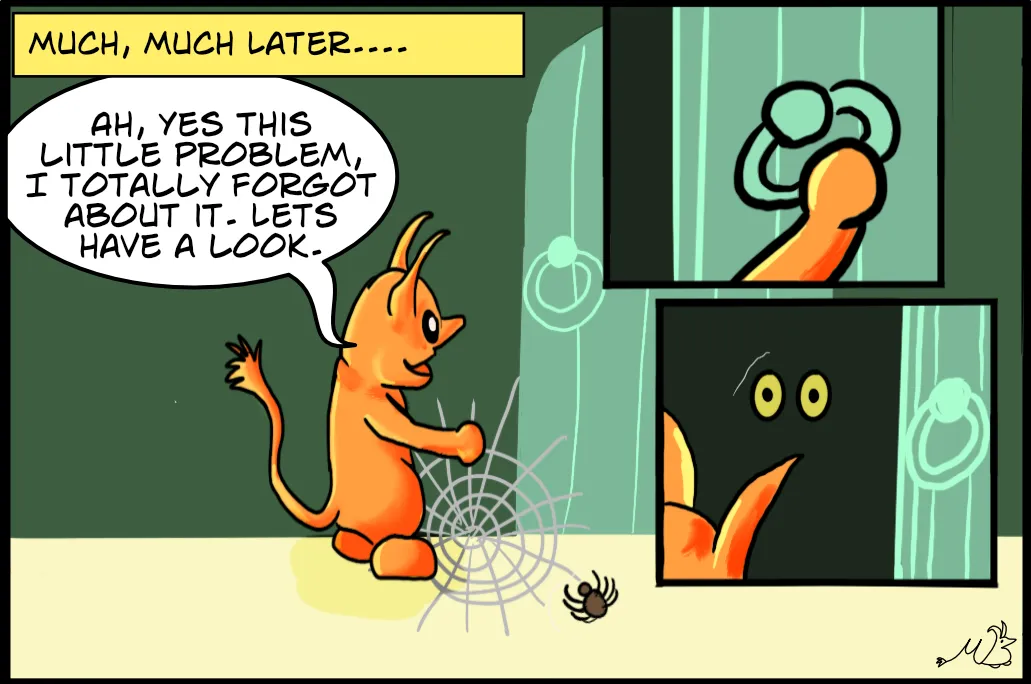
Panel 5. Caption: “Much, much later....” Vige brushes away the web: “Ah, yes this little problem, I totally forgot about it. Lets have a look.” Vige opens the door. Yellow eyes glow in the dark.

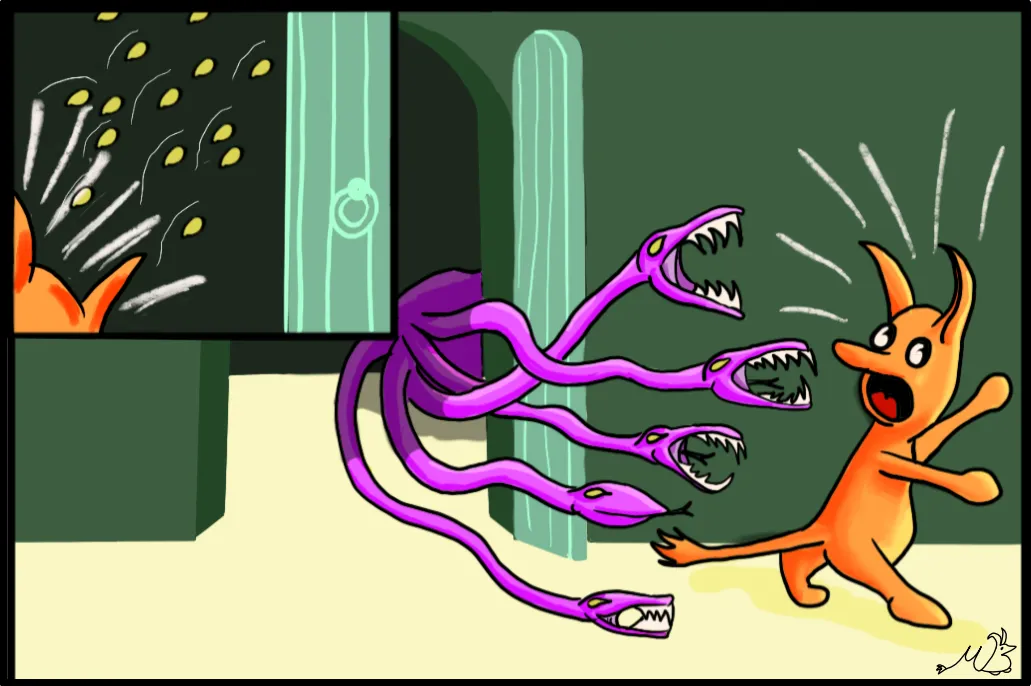
Panel 6. A huge purple monster with five snake heads bursts out of the door at a terrified Vige.