Skip to content
Menu
Vige
Quick foot

Bloggtoons

Vige in the Cynefin Field Guide

In October The Cynefin Company released a new book, The Cynefin Co. Field Guide: Cynefin in the age of entanglement. Chapter 3 includes my illustration Cynefin in 3D, with the Vige trolls in it. I made it together with Christopher Bramley and Rob England. This is what Dave Snowden writes about it in the book:

“The best we have seen is this one by Rob England, Martin Berg, and Christopher Bramley.”
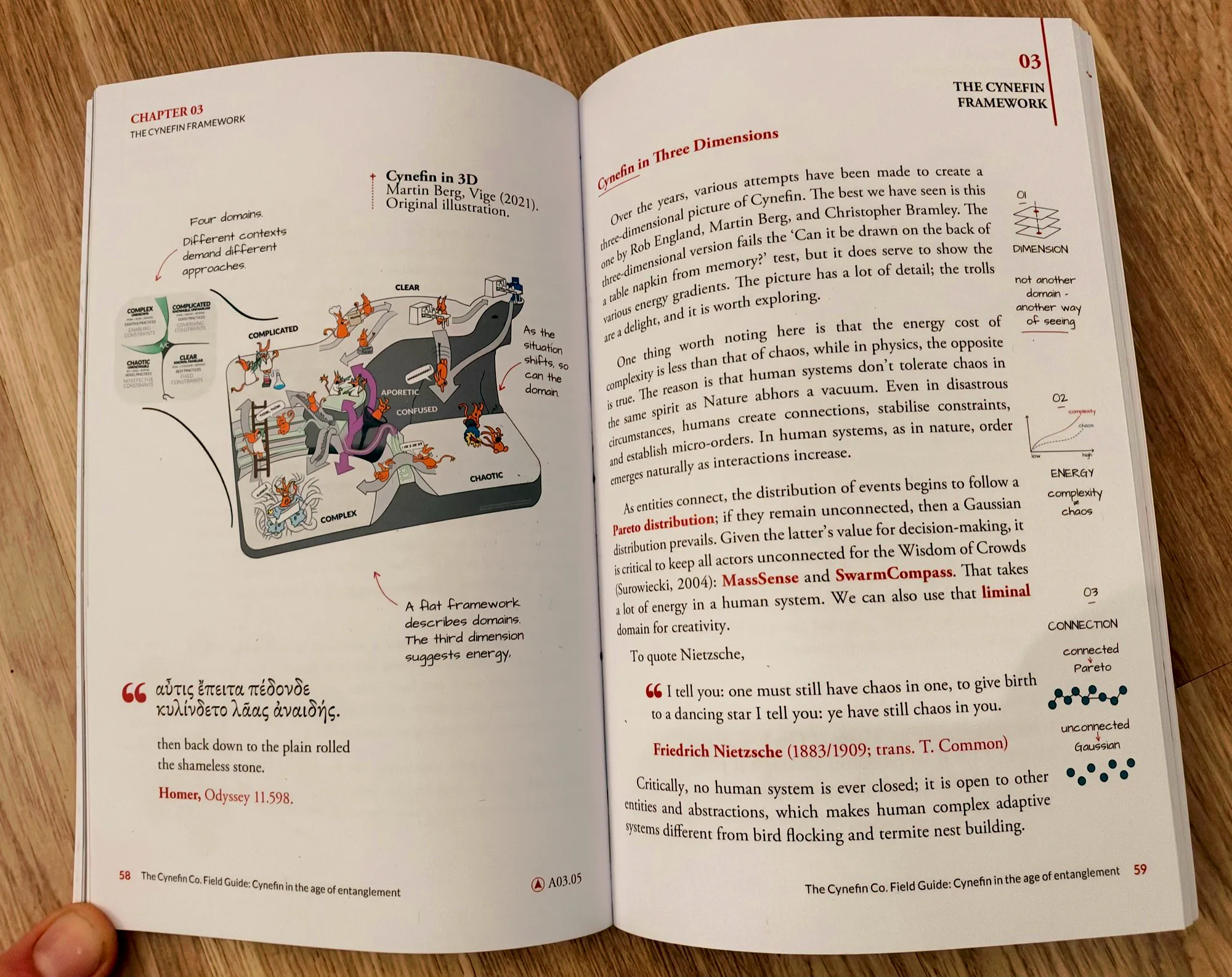
A spread in The Cynefin Co. Field Guide with the illustration Cynefin in 3D on the left page and the text Cynefin in Three Dimensions on the right page

The spread from The Cynefin Co. Field Guide is shown with permission from Dave Snowden.

From an idea to a field guide

It started in June 2020. I had been fascinated by Dave Snowden’s work and the Cynefin framework for a long time, and got the idea to illustrate it in the Vige surroundings. With help from my colleagues at Squeed, the first version was done. A few days later it was available in high resolution for anyone who wanted to use it.

In October 2020 the trolls were part of the book Cynefin - weaving sense making into the fabric of our world. That Christmas they got a Christmas version, and in 2021 I made three new versions: Basic, Basic with transactions and Full. Now the trolls are in the Field Guide too.

Why is Chaotic higher than Complex?

That is the question I get most often about the picture. I have written the answer on the Both&More blog: Why is Chaotic higher than Complex?

All versions of the picture are available in high resolution on the Cynefin page. Feel free to use them, and credit me, Christopher Bramley and Rob England.

You can find the book at The Cynefin Company.
Alignment and autonomy - it needs to be a mess

A few weeks ago, I wrote a short LinkedIn post on alignment and autonomy as being a polarity and not an either-or situation. I got good feedback and reflections on this. Below I will explain my reasoning on why I view these as a polarity to each other and more how to find strategies to get into a “both and” perspective suitable needed for polarities.


Alignment and Autonomy are critical areas within a company:

Autonomy is vital as it allows employees to make decisions and steer their work. This independence can spur innovation and quick adaptation to change, boosting motivation.

Alignment is crucial in a company it ensures that everyone understands and works towards the same strategic objectives, leading to clear direction, improved efficiency, and focused decision-making.

But they are also often in combat with each other, this happens when you apply an either or thinking to them. By instead viewing them as polarities and making use of Polarity Management, we can find strategies that will be helpful for us in our leadership.

Polarity Management is a framework used to deal with issues that are ongoing, interdependent, and have no final solution. These are often referred to as “unsolvable problems” because they are based on values that are in tension with each other, yet both are necessary for a successful outcome.

Polarity management would involve recognizing that Alignment and Autonomy are two poles of a continuum, both of which are necessary for the organization’s health and success.


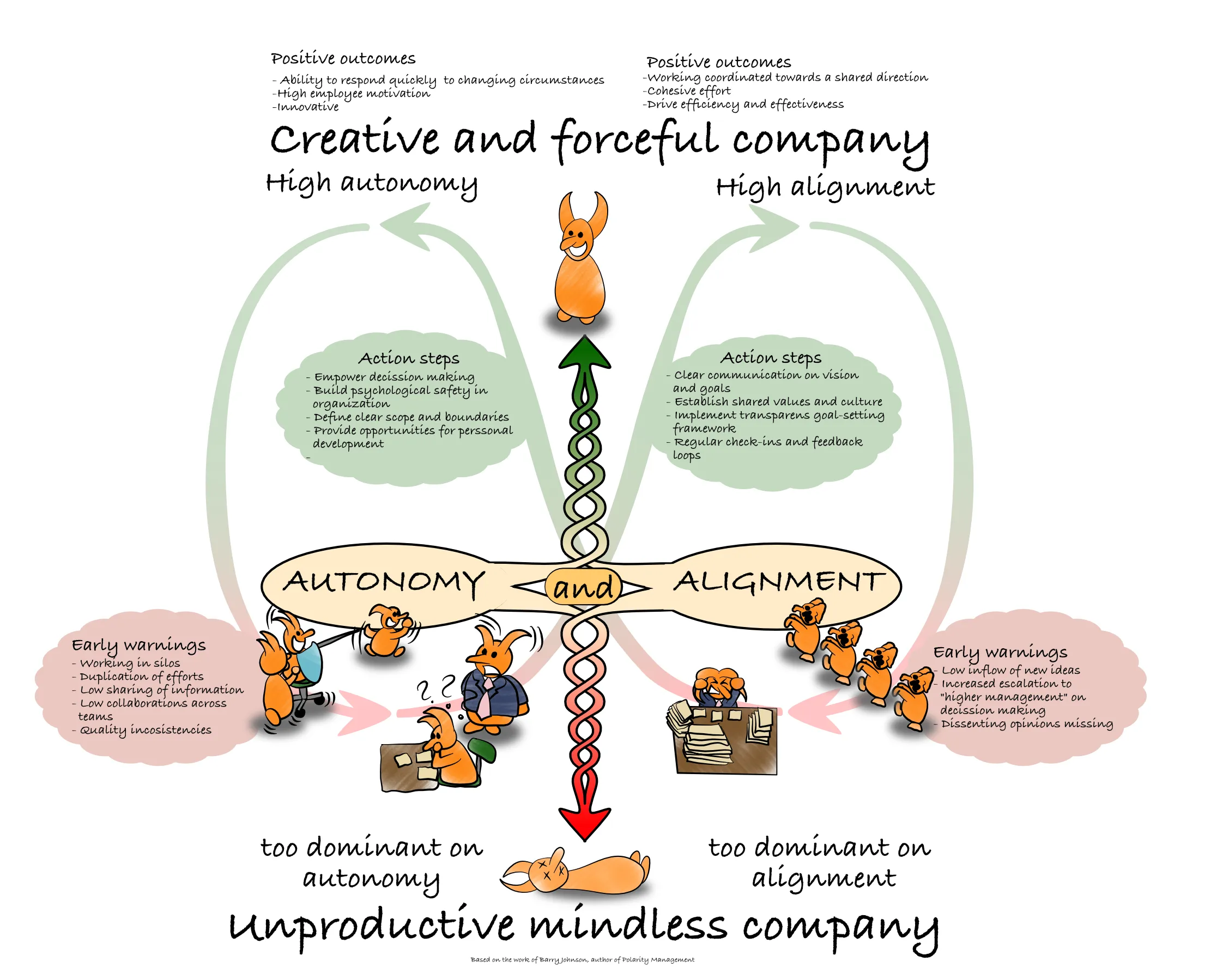
Let us put alignment and autonomy on the polarity map as presented in the picture below. When reading the picture, you will find my proposed “action steps” and “early warnings” to be aware of for each polarity.


On the left side, we have Autonomy and its connected “action steps” that will help to increase autonomy and the “early warnings” that we need to be aware of so that we can mitigate negative aspects of autonomy. We mitigate using “action steps” on the Alignment side. Here, we also have “early warnings” that we need to be aware of, which, in turn, can be mitigated by actions on the Autonomy side, and so it continues when we manage to create a good harmony between the two.

Polarity map for autonomy and alignment, drawn with Vige figures. Top: “Creative and forceful company”, with high autonomy on the left and high alignment on the right. Bottom: “Unproductive mindless company”. Each side lists positive outcomes, action steps and early warnings, as described in the text below the picture. Based on the work of Barry Johnson.

So, for example, we can see that an early warning for going too dominant on autonomy is “working in silos,” making the communication on vision and goals, and establishing transparent goal-setting frameworks can help to mitigate those negative effects on autonomy.


On the other hand, an early warning for too dominant alignment is that one can see an escalation of decisions moving higher and higher into the hierarchical ladder of the organization. This can be mitigated by empowering decision-making, such as consent decision-making.


Polarity Management can be used in many other types of polarities…

  • Short-term vs. Long-term Focus: Navigating between focusing on immediate results and quick wins (short-term focus) and investing in long-term goals and strategies (long-term focus).
  • Profit vs. Purpose: Managing the polarity between focusing on profitability and financial success (profit) and staying true to the company’s mission and values (purpose).
  • Planning vs. Action: Balancing thorough, careful planning against the need to take swift action and be adaptable.
  • Innovation vs. Operational Efficiency: Managing the tension between fostering innovation and creativity against the need to maintain efficient, reliable operations.

…just to name a few. Depending on your own situation and needs, the action steps and the early warnings can be different so my suggestion is to build your own set of polarity management maps and get a better understanding of the strategies that you need to develop so that actions you take enhance the different polarities and not cancel each other out or even worse, deteriorate the other polarity.


If would like to have a template to try it out, we have one ready for you at this location:

The shape of Leadership through a Child’s Eyes

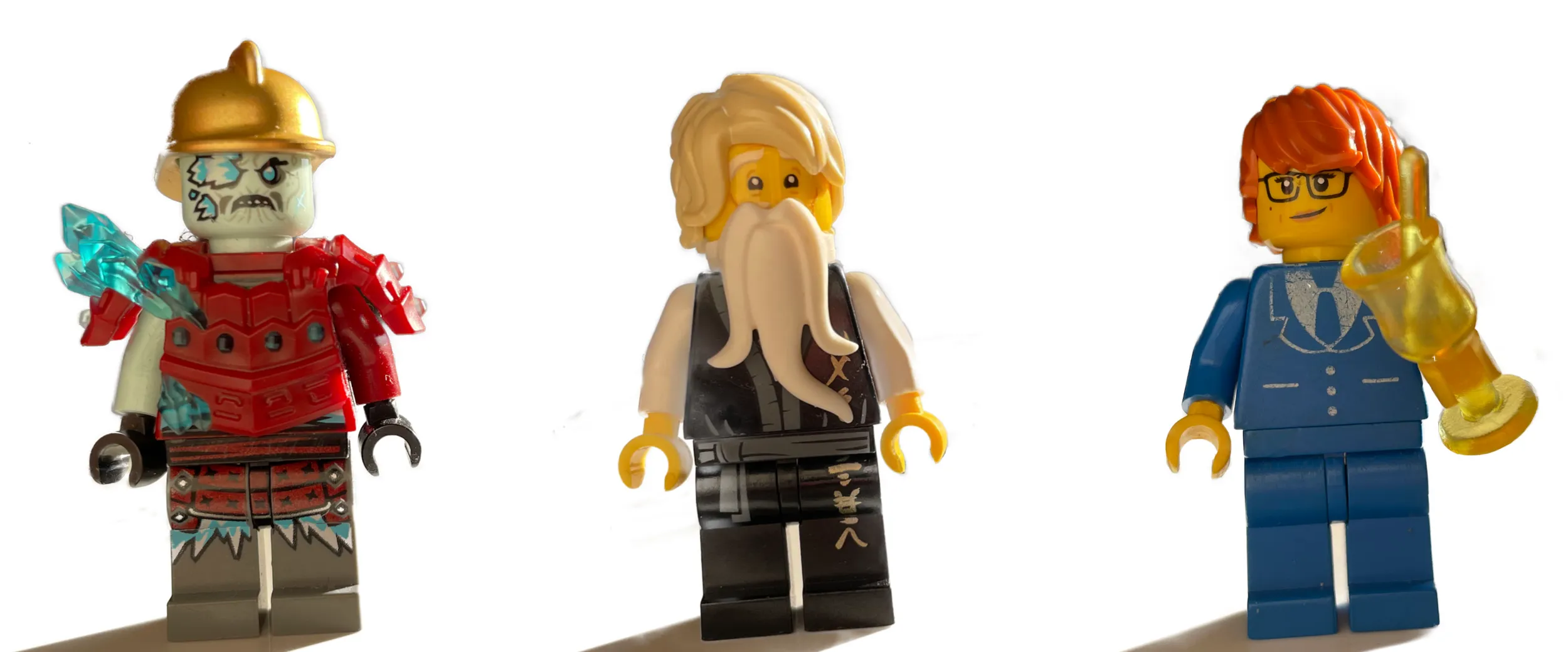
As my son eagerly connected one Lego piece to another, his spontaneous exclamation caught my attention, “Let’s build a boss, Dad!” Intrigued, I joined in, curious to see how his young mind perceived leadership.

The first character took shape under his nimble fingers – a stern-looking figure, with furrowed brows and a rigid stance. Observing his creation, I couldn’t help but ask, “Why does the boss look so angry?”

“A boss has to be like that; like Putin,” he replied earnestly.

I probed further, “Is this what a good boss looks like?”

“No way,” he shook his head, “this is not a good boss.”

And so, the journey continued. “Show me, what does a good boss look like?” I asked.

Three Lego figures: a stern warrior in red armour with a gold helmet and an angry face, a wise old man with a long white beard in a black robe, and a smiling woman in a blue suit holding a glass.

His hands worked diligently, constructing a figure with a kinder appearance and a softer expression. “This is a good boss,” he declared, proudly presenting the second character.

Intrigued, I asked, “And what makes him a good boss?”

“He’s wise and kind. He cares about others and helps them improve,” he explained with a smile.

I felt a swell of pride – my son’s vision of a good leader was rooted in compassion and wisdom. Yet, he wasn’t done. There was one more character to build.

“This one is an even better boss to be,” he asserted, creating a character leisurely leaning back, drink in hand.

Curious, I asked, “And why is that?”

“He’s got it easy, watching the others work while he relaxes,” he said, a twinkle in his eye.

I burst into laughter, marveling at my son’s ability to infuse humor and a playful twist into our Lego-building session.

As we packed away the Lego pieces, I couldn’t shake the images of the three bosses from my mind. It struck me how, even at a young age, we carry distinct mental pictures of leadership – images shaped by the world around us. The stern leader, the wise and kind mentor, and the laid-back boss – all coexist in our perceptions, influencing how we navigate the world of work and leadership.

I invite you to reflect on the story of the Lego bosses and share your thoughts. What mental images of leadership have you carried since childhood? How do they align or differ from my son’s Lego bosses? And most importantly, how do these images shape your expectations of leaders and yourself as a leader today?

Let’s come together and unravel the tapestry of leadership perceptions, learning from the candid innocence of a child’s imagination and understanding how these early images continue to impact us. Join the conversation, and let’s explore the mental pictures of leadership within us all.

Plain logic

So many side effects on budgets and the age-old ways that is blocking us from asking what is the right thing to do and instead asking, does it fit in the budget?

Inspiration from the Agility in Finance course with Agile People and Beyond Budgeting Institute.


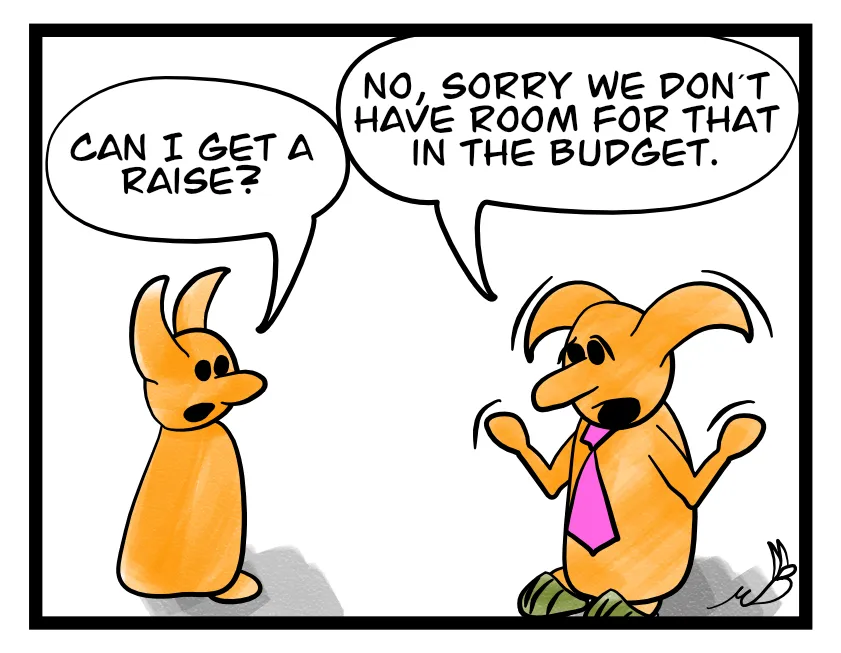
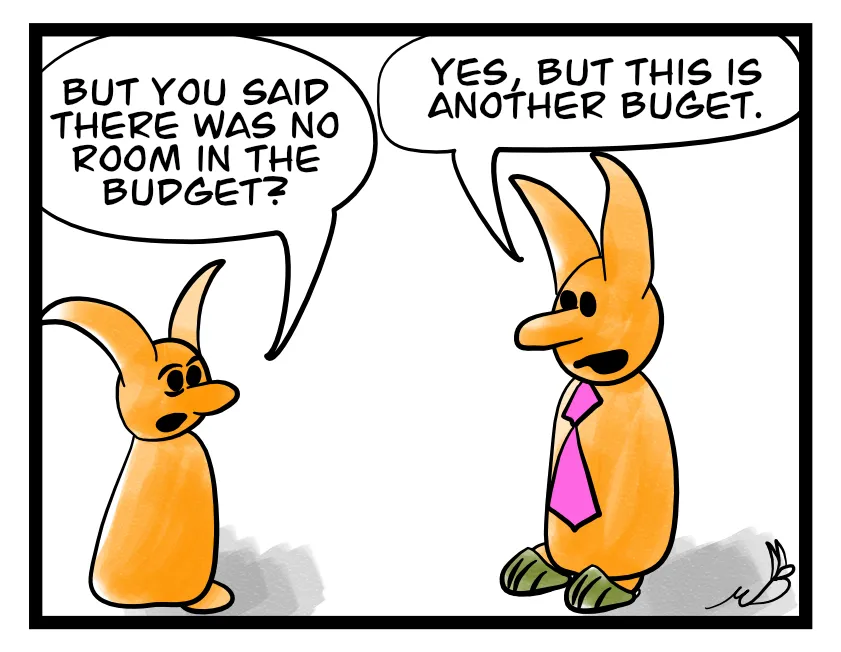
Comic panel 1. An employee asks: “Can I get a raise?” The boss in a pink tie shrugs: “No, sorry we don’t have room for that in the budget.”

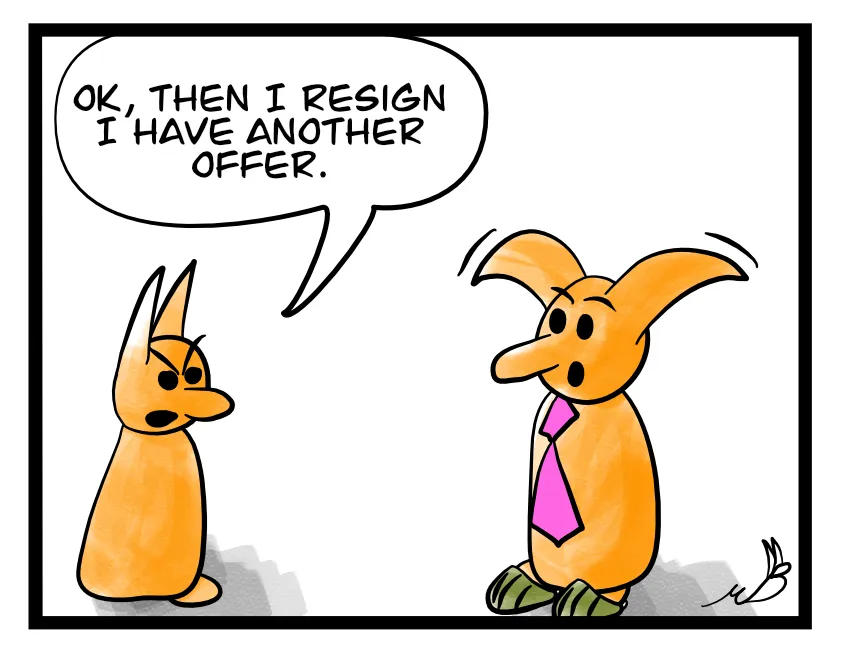
Panel 2. The employee, annoyed: “Ok, then I resign. I have another offer.” The boss looks surprised.

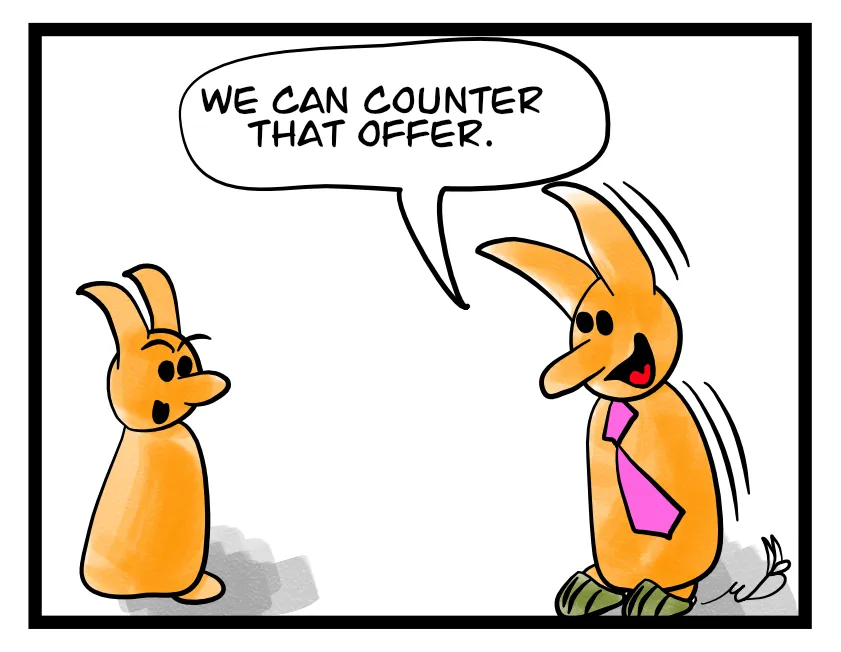
Panel 3. The boss, eager: “We can counter that offer.”

Panel 4. The employee: “But you said there was no room in the budget?” The boss: “Yes, but this is another budget.”